
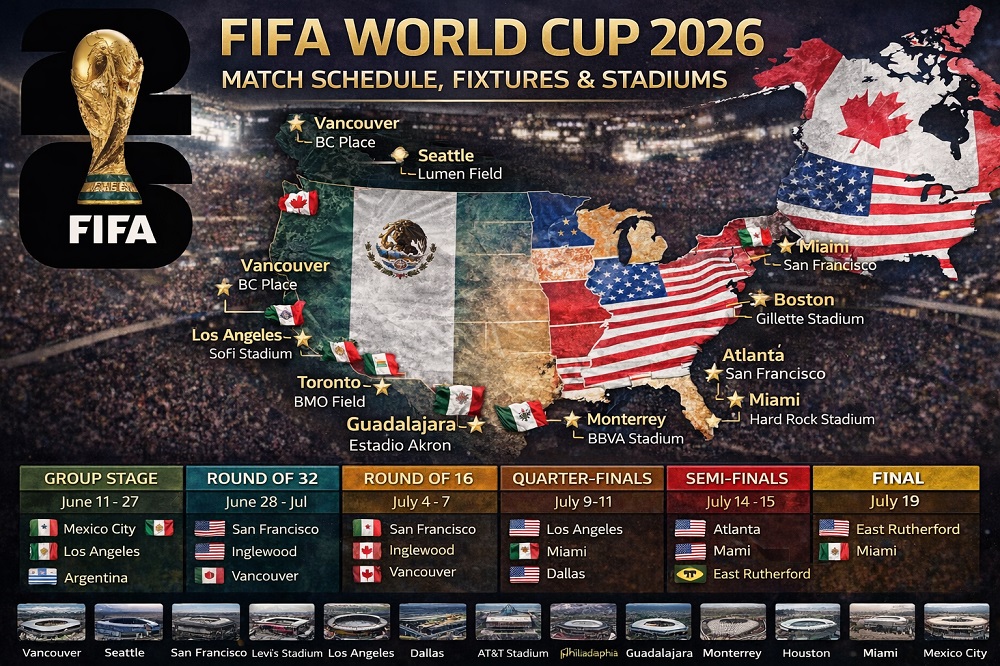
The FIFA World Cup 2026 is set to be the biggest tournament in football history, featuring 48 teams and hosted across three nations—the United States, Canada, and Mexico. Here’s a clear, SEO-friendly breakdown of the match schedule, fixtures, and stadiums.
Tournament Overview
The 2026 edition will be the first to feature 48 teams, expanded from 32.
A total of 104 matches will be played.
The tournament is expected to run from June to July 2026.
Matches will be spread across 16 host cities in three countries.
Match Schedule Format
Teams will be divided into 12 groups of 4 teams each.
Each team plays 3 group-stage matches.
The top 2 teams from each group + 8 best third-placed teams advance.
Knockout rounds include:
Round of 32 (new addition)
Round of 16
Quarter-finals
Semi-finals
Final
Key Fixture Highlights
Opening Match: Expected to be held in Mexico, continuing the tradition from past tournaments.
Group Stage Matches: Spread across all host cities for wider fan access.
Knockout Stage: Gradually shifts to major stadiums in the U.S.
Final Match: Likely to take place in a large-capacity U.S. stadium, with venues like MetLife Stadium being strong contenders.
Host Cities & Stadiums (United States)
New York/New Jersey – MetLife Stadium
Los Angeles – SoFi Stadium
Dallas – AT&T Stadium
Miami – Hard Rock Stadium
Atlanta – Mercedes-Benz Stadium
Seattle – Lumen Field
San Francisco Bay Area – Levi’s Stadium
Boston – Gillette Stadium
Houston – NRG Stadium
Philadelphia – Lincoln Financial Field
Kansas City – Arrowhead Stadium
Host Cities & Stadiums (Canada)
Toronto – BMO Field
Vancouver – BC Place Stadium
Host Cities & Stadiums (Mexico)
Mexico City – Estadio Azteca
Guadalajara – Estadio Akron
Monterrey – Estadio BBVA
Stadium Features & Capacity
Many stadiums have capacities exceeding 60,000 seats.
Modern venues like SoFi Stadium offer state-of-the-art technology and a fan experience.
Historic stadiums like Estadio Azteca bring a rich football heritage.
Travel & Match Accessibility
Matches are geographically spread to ensure regional balance.
Fans can follow teams across nearby cities during the group stages.
Efficient transport systems in host countries improve accessibility.
Why the FIFA World Cup 2026 Is Unique
First three-nation hosting in World Cup history.
Largest number of teams and matches ever.
Greater global representation and fan engagement.
The FIFA World Cup 2026 promises an unprecedented football spectacle. With an expanded format, world-class stadiums, and a diverse schedule, fans can expect thrilling fixtures from start to finish. Whether you’re tracking match schedules or planning stadium visits, this tournament will redefine the global football experience.
 today_240